Can we believe in Epiphany?
 The Feast of the Epiphany in the church's liturgical calendar is based on the events of Matt two.1–12, the visit of the 'wise men' from the East to the infant Jesus. At that place are plenty of things nigh the story which might make us instinctively treat information technology as simply some other part of the constellation of Christmas traditions, which does not have very much connection with reality.
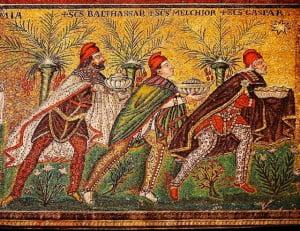
The first is the sparseness of the story. As with other parts of the gospels, the details are given to us in bare outline compared with what we are used to in modern literature. We are told little of the historical reality that might interest us, and the temptation is to fill in details for ourselves. This leads to the 2nd issue—the development of sometimes quite elaborate traditions which do the work of filling in for us. Then these 'magoi' (which gives us our discussion 'magic') became 'three' (because of the number of their gifts), and so 'wise men' and so 'kings' (probably under the influence of Ps 72.10. By the time of this Roman mosaic from the church building in Ravenna congenital in 547, they have fifty-fifty caused names. Christopher Howse comments:
In response to this, critical scholarship has moved in the other direction, and past and large has pulled apart Matthew's story and confidently decided it that none of it actually happened. Instead, information technology was constructed by Matthew out of a series of OT texts in order to tell us the real significance of Jesus. So Marcus Borg and Dominic Crossan, inThe First Christmas: what the gospels really teach near Jesus' birth, come to this conclusion:
In our judgement, there was no special star, no wise men and no plot by Herod to kill Jesus. So is the story factually truthful? No. But as a parable, is it true? For us as Christians, the respond is a robust affirmative. Is Jesus low-cal shining in the darkness? Yep. Do the Herods of this earth seek to extinguish the light? Yes, Does Jesus still polish in the darkness? Yes. (p 184).
The approach presents issues of its ain. For one, the stories are not presented as parables, only in continuity with the events Matthew relates in Jesus' life later in the gospel. For another, if God in Jesus did not outwit Herod, on what grounds might we think he can outwit 'the Herods of this world'? More fundamentally, Matthew and his get-go readers appeared to believe that the claims well-nigh Jesus were 'parabolically true' because these things actually happened. If none of them did, what grounds practice nosotros now have? Even if the events we read about are heavily interpreted, there is an irreducible facticity in testimony; if this has gone, we ought to question the value of the testimony itself.
A good working example of this approach is found in Paul Davidson'southward web log. Davidson is a professional person translator, rather than a biblical studies academic, but he offers a practiced outline of what critical scholarship has to say about Matthew's nativity.
His bones assumption is that Matthew is a 'multi-layered' document—Matthew is writing from the ground of other, differing sources. He takes over large parts of Mark's gospel, as does Luke, and Matthew and Luke never hold in contradiction to Mark, a key slice of the argument of 'Marcan priority', that Mark was earlier than either of the other two. Whether or not you believe in the existence of the so-chosen Q, another early written source (and with Marking Goodacre, I don't), Matthew is clearly dealing with some pre-existing textile, oral or written. It is striking, for case, that Joseph is a fundamental character in Matthew'south business relationship before and after the story of the magi, and is the key actor in contrast to Luke's nascency, where the women are central. Yet in this section (Matt 2.1–12) the focus is on 'the kid' or 'the kid and his mother Mary' (Matt 2.nine, 2.xi; run into likewise Matt 2.14, 20 and 21). Some scholars therefore argue that this story comes from a different source, and so might be unhistorical.
This is where we need to kickoff being disquisitional of criticism. Treatment texts in this way requires the making of some bold assumptions, non least that of writer invariants. If a change of mode indicates a change of source, then this can merely be seen if the writer is absolutely consistent in his (or her) ain writing, and fails to brand the source cloth his or her own. In other words, we (at 20 centuries afar) need to be a lot smarter than the writer him- or herself. Even a basic appreciation of writing suggests that authors are merely not that consistent.
Davidson goes on in his exploration to explain the story of the star in terms of OT source texts.
The basis for the star and the magi comes from Numbers 22–24, a story in which Balaam, a soothsayer from the e (and a magus in Jewish tradition) foretells the coming of a great ruler "out of Jacob". Significantly, the Greek version of this passage has messianic overtones, every bit information technology replaces "sceptre" in 24:17 with "homo."
He is quite right to identify the connections hither; any good commentary volition point out these allusions, and information technology would be surprising if Matthew, writing what most would regard as a 'Jewish' gospel, was not aware of this. Simply if he is using these texts as a 'source', he is non doing a very skilful job. The star points to Jesus, but Jesus is not described as a 'star', and no gospels make utilise of this as a championship. In fact, this is the only place where the word 'star' occurs in the gospel. (It does occur as a title in Rev 22.16, and possibly in 2 Peter 1.nineteen, simply neither brand any connection with this passage.)
Next, Davidson looks at the citation in Matt two.five–vi, which for many critical scholars provides the rationale for a passage explaining that Jesus was born in Bethlehem when he is otherwise universally known as 'Jesus of Nazareth' (nineteen times in all four gospels and Acts). Merely, as Davidson points out, Matthew has to work hard to go these texts to aid him. For one, he has to bolt together two texts which are otherwise completely unconnected, from Micah v.2 and ii Sam 5.2. Secondly, he has to alter the text of Micah five.2 so that:
- Bethlehem, the 'least' of the cities of Judah, now becomes 'by no means the least';
- the well-known epithet 'Ephrathah' becomes 'Judah' to make the geography clear; and
- the 'clans' becomes 'clan leader' i.e. 'ruler' to make the text relevant.
Moreover, Matthew is making apply of a text which was non known every bit 'messianic'; in the kickoff century, the thought that messiah had to come from Bethlehem equally a son of David was known but not very widespread.
All this is rather bad news for those who would argue that Jesus' nascence was advisedly planned to be a literal fulfilment of OT prophecy. But it is every bit bad news for those who contend that Matthew made the story up to fit such texts, and for exactly the aforementioned reason. Of course, Matthew is working in a context where midrashic reading of texts ways that they are a good bargain more flexible than we would consider them. But he is needing to brand maximum use of this flexibility, and the logical decision of this would be that he was constrained by the other sources he is using—by the business relationship he has of what actually happened.
 Davidson now turns to consider the magi and the star. He notes a sure coherence up to the point where the magi arrive in Jerusalem.
And so far, the story makes logical sense despite its theological issues (eastward.k. the fact that information technology encourages people to believe in the "deceptive scientific discipline of astrology", as Strauss noted). The star is just that: a star.
Then everything changes. The star is transformed into an atmospheric light that guides the magi right from Jerusalem to Bethlehem, where it hovers overa unmarried firm—the one where the child is. Nosotros are no longer dealing with a distant celestial body, but something else entirely, like a pixie or will-o'-the-wisp.
Here over again disquisitional assumptions need some critical reflection. Matthew'due south inclusion of magi is theologically very problematic indeed. Simon Magus and Elymas (Acts eight.nine, thirteen.8) hardly get a good press, not surprising in calorie-free of OT prohibitions on sorcery, magic and astrology. Western romanticism has embraced the Epiphany as a suggestive mystery, but earlier readings (like that of Irenaeus) saw the betoken as the humiliation of paganism; the giving of the gifts was an act of submission and capitulation to a greater power. For Matthew the Jew, they are an unlikely and risky feature to include, peculiarly when Jesus is clear he has come to the 'lost sheep of the house of State of israel' (Matt 10.6, fifteen.24).
There accept been many attempts to explain the appearance of the star scientifically. The best contenders are a comet (for which there is no independence evidence), a supernova (observed past the Chinese in 4 BC) or the conjunction of Jupiter with Saturn in the constellation Pisces. I think the latter is the all-time candidate; Jupiter signified 'leader', Saturn denoted 'the Westland', and Pisces stood for 'the end of the age'. Then this conjunction would communicate to astrologers 'A leader in the Westland [Palestine] in the end days.' This highlights a key problem with Davidson'southward criticism; the issue is not whether a star could in fact betoken a detail house in our, mod scientific terms. This is clearly impossible. The existent issue is whether Matthew thought it could—or even whether Matthew thought the magi thought it could. As Dick France highlights in his NICNT commentary, this was actually a common agreement for which we have documentary bear witness. And whatever naturalistic explanations miss Matthew'southward fundamental point: this was something miraculous provided by God. If yous don't think the miraculous is possible, you are bound to disbelieve Matthew's story—but on the basis of your own assumptions, non on any criteria of historical reliability or the nature of Matthew's text.
Davidson cites the 19th-century rationalist critic David Friedrich Strauss in his objection to the plausibility of Herod's activeness:
With regard to Herod'south instructions to report back to him, Strauss notes that surely the magi would have seen through his plan at once. There were besides less clumsy methods Herod might have used to discover out where the child was; why did he not, for example, send companions along with the magi to Bethlehem?
In fact, we know from Josephus that Herod had a fondness for using undercover spies. And in terms of the story, the magi are unaware of Herod'southward motives; we are deploying our prior cognition of the effect to decide what we think Herod ought to accept done, which is hardly a good basis for questioning Matthew'southward brownie.
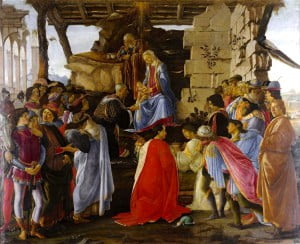 Finally, we come up to the arrival of the magiat the habitation of the family. Interestingly, Matthew talks of their 'house' (Matt 2.11) which supports the thought that Jesus was not born in a stable—though from the age of children Herod has executed (less than ii years) we should think of the magi arriving some time subsequently the nativity. No shepherds and magi together hither!
Davidson again sees (with critical scholars) this event synthetic from OT texts:
According to Brown, Goulder (2004), and others, the Onetime Testament provided the inspiration for the gifts of the magi. This passage is an implicit citation of Isaiah 60.3, half-dozen and Psalm 72.10, 15, which describe the bringing of gifts in homage to the king, God's imperial son.
But again, the problem hither is that Matthew's account merely doesn't fit very well. Given that these OT texts uniformly mention kings, not magi, if Matthew was amalgam his account from these, why cull the embarrassing astrologers? And why three gifts rather than ii? Where has the myrrh come from? Over again, it is Irenaeus who first interprets the gifts every bit indicators of kingship, priesthood and sacrificial decease respectively, but Matthew does non appear to do so. In the narrative, they are simply extravagant gifts fit for the true 'king of the Jews'. Subsequent tradition has to do the piece of work that Matthew has hither failed to practise, and brand the story fit the prophecies rather better than Matthew has managed to.
Davidson closes his analysis of this department with a concluding observation from Strauss:
If the magi can receive divine guidance in dreams, why are they non told in a dream to avert Jerusalem and go straight to Bethlehem in the first place? Many innocent lives would have been saved that way.
Clearly, God could have done a much ameliorate job of the whole business organization. Just it rather appears as though Matthew felt unable to improve on what happened by plumbing equipment it either to the OT texts or his sense of what ought to have happened.
The modern reader might struggle with aspects of Matthew's story. But information technology seems to me you can only dismiss it by making a large number of other, unwarranted assumptions.
(First published in 2015)
If you enjoyed this, do share it on social media, mayhap using the buttons on the left. Follow me on Twitter @psephizo.Like my page on Facebook.
Much of my work is done on a freelance basis. If you have valued this mail, would y'all considerdonating £ane.20 a calendar month to support the production of this weblog?
Source: https://www.psephizo.com/biblical-studies/can-we-believe-in-epiphany/
0 Response to "Can we believe in Epiphany?"
Post a Comment